
4 AI Prompts that Guarantee Mediocre Marketing (and the Office 365 Lesson Tech Companies Keep Repeating)
If your AI-generated marketing sounds like everyone else’s, it’s not because AI doesn’t work. It’s because AI is doing exactly what you told it to do. We’ve seen this before.
The “24/7/365” Era
When Microsoft Office 365 launched, every Microsoft partner had a story. And every one of them told it the same way:
“What makes us different is our 24/7/365 customer service.”
They:
Served every industry
Targeted every company size
Sold to every role
Which meant…they weren’t different at all.
When we pushed deeper, we heard:
“We can help anyone.”
“Office 365 applies to every business.”
“We don’t want to limit ourselves to one industry.”
“Our service is just better.”
It made them indistinguishable. The partners that kept the generic message competed on price. Those that were willing to focus? They won bigger, stickier deals.
We worked with partners on basic marketing strategy and best practices:
Choose a specific industry
Identify the real buyer(s)
Clarify the business pain driving the decision
Build a value proposition rooted in outcomes, not features
Instead of “24/7/365 support for Office 365” they began saying things like:
“Reducing compliance risk for multi-location healthcare providers.”
“Helping regional banks modernize collaboration while meeting regulatory requirements.”
“Enabling distributed law firms to collaborate securely across jurisdictions.”
Same platform. Same capabilities. Completely different positioning. That shift changed how the prospects perceived their value.
Now AI is Exposing the Same Weakness
Today, we see teams using AI like this:
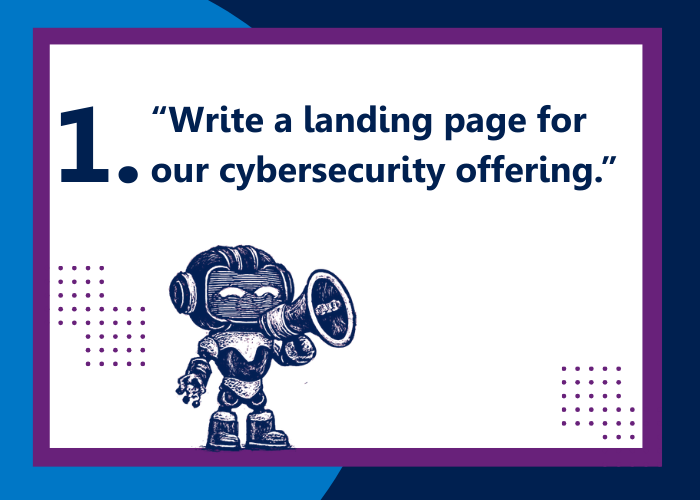
Why it fails:
No defined target audience
No industry focus
No buyer-stage clarity
AI defaults to: Comprehensive. Scalable. End-to-end. Cutting-edge protection.
It sounds polished. It also sounds exactly like everyone else. Without a defined audience (CISO at a mid-market healthcare system?) and a defined buyer stage (awareness vs. evaluation?), AI can’t differentiate. It can only generalize.
Whatever it is, the way you tell your story online can make all the difference.
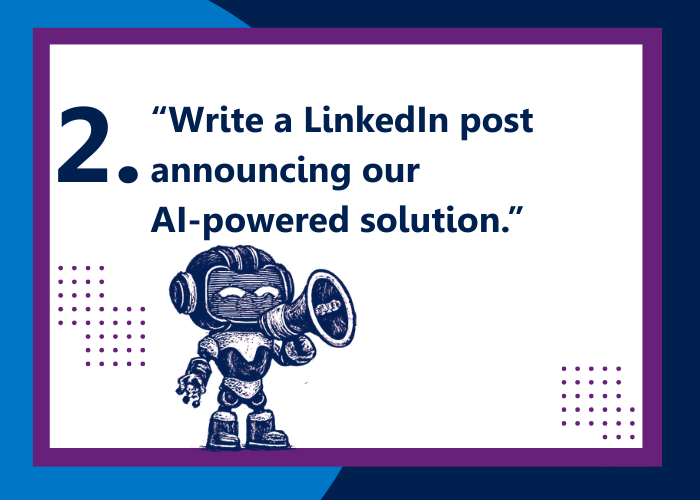
Why it fails:
No positioning context
No clear business driver
No urgency
No differentiation
You’ll get: We’re excited to announce our new AI-powered platform that drives efficiency and unlocks innovation…
That’s not positioning. That’s noise.
In B2B technology marketing, “AI-powered” is not a strategy. It’s table stakes.
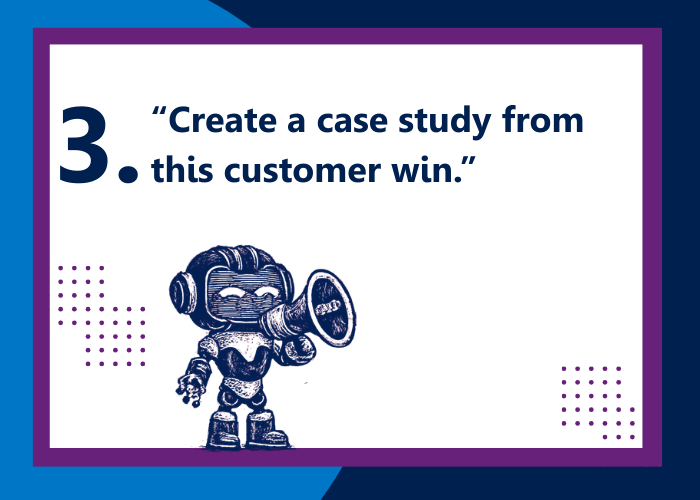
Why it fails:
No narrative
No quantified impact
No industry lens
No decision criteria
AI summarizes events: The customer faced challenges. We implemented our solution. They saw improvements.
That’s a recap. Not a persuasive story. Strong case studies follow structure:
Market context
Specific business problem
Stakes and risk
Decision logic
Measurable outcomes
Strategic impact
If you don’t give AI that structure, it won’t invent it.
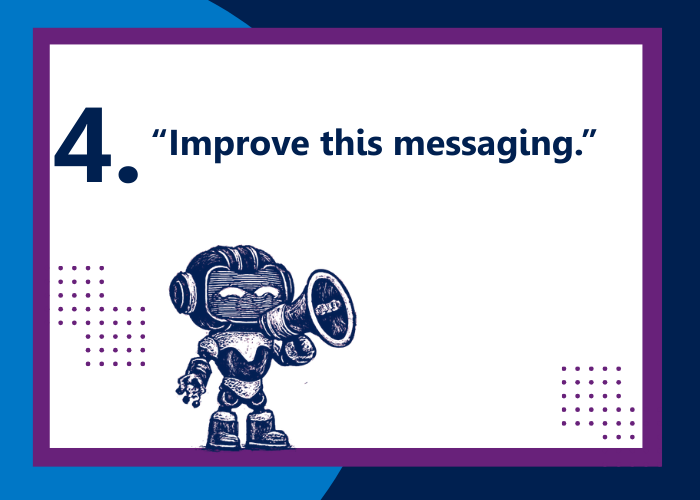
Why it fails:
No target persona
No buying stage
No competitive frame
No value thesis
AI can tighten language.
It cannot decide:
Whether this is for enterprise or mid-market
Whether you’re targeting operations or IT
Whether your edge is risk reduction, improved efficiency, or cost control
Without strategy, AI optimizes surface language — not substance.
The Pattern is the Same
Back then, “24/7/365 service” felt like differentiation. It wasn’t. Today, “AI-powered” feels like differentiation. It isn’t.
The technology changes. The marketing mistakes stay the same. Broad targeting. Generic positioning. Feature-led storytelling. No industry focus. No buyer-stage alignment.
AI doesn’t fix that. It accelerates it.
AI Amplifies Strategy — It Doesn’t Replace It
The teams seeing real results with AI aren’t using magical prompts. They’re feeding AI:
A clearly defined target audience
A specific industry focus
A known buyer stage
A differentiated value proposition
With that foundation, AI becomes a multiplier. Without it, AI becomes a volume machine for mediocrity.
Why We Built the AI-Ready Messaging Framework
We didn’t build our Messaging Framework to help companies produce more content. We built it to help technology companies:
Clarify who they actually want to win
Define where they compete
Align messaging to buyer stage
Build a differentiated value story
Create proof that supports real business outcomes
Once that strategic foundation exists, AI becomes powerful. It can:
Scale consistent messaging
Accelerate campaign development
Generate variations aligned to buying stages
Support sales enablement with precision
But it needs something strong to amplify. Because if your AI-generated marketing sounds like everyone else’s…It’s not because AI doesn’t work. It’s because it’s doing exactly what you told it to do.
If your AI marketing sounds like everyone else’s, it’s time to give it something worth saying. Build your AI-Ready Messaging Framework™ today and create a machine-ready intelligence layer that amplifies your differentiation, not your mediocrity.